
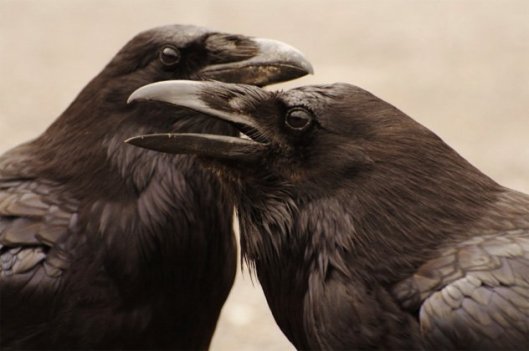
A distinct black shape, tumbling in the updrafts of a mountain crag – a raven at play. The ‘gronking’ call of a raven is one of the most evocative sounds of Britain’s uplands. The raven is probably the world’s most intelligent and playful bird. In the world of myth, it is a bird of paradox, and something of a dark clown. Its association with playful intelligence is perhaps exceeded by its image as a bird of death. Its harsh call, and its presence in remote wild places and at scenes of death, has earned it a reputation as a bird of ill-omen. After all, the old collective noun for a group of ravens is an ‘unkindness’. Yet there is so much more to the raven.
An old Scottish name for the raven is ‘corbie’, which is thought to have been derived from the Latin ‘corvus’. One Scottish legend reflects the dark beliefs about this bird. It tells of an evil hag called Cailleach who appeared in the form of a number of birds, including the raven, and feasted on men’s bodies.
This large crow appears again and again in Celtic lore. In Welsh folklore, Bran the Blessed (Bran is Welsh for raven) is a kind of primordial deity and guardian of Britain whose totem is a raven. Bran ordered for his own head to be cut off, after which it could still speak words of prophecy. Eventually it was said to have been buried beneath Tower Hill, at the Tower of London. The presence of ravens at the Tower is an echo of this legend and the prophecy says that if the ravens ever leave the tower, Britain will fall (hence their wings are clipped, just in case!). Interestingly this Welsh word appears in Scotland, and Strath Bran, in the north translates as ‘Strath’ or Valley of the Raven. They are still present there today.
Arthur, another legendary guardian of Britain, is also associated with ravens. In Cornwall, which is also steeped in Celtic lore, it was believed that Arthur didn’t really die, but was magically transformed into this bird.
The Celts were a warlike people, and the presence of ravens on the battlefield would have been very familiar to them. The Irish goddess, Morrighan, had a number of different guises. In her aspect as bloodthirsty goddess of war, she was thought to be present on the battlefield in the form of a raven.
Odin (Wōden), the chief of the Norse gods, was accompanied by a pair of ravens, Hugin (thought) and Munin (memory/mind), who would fly far and wide to bring news to Odin. One of Odin’s names, Hrafnagud, means the ‘Raven God’. I refer to these two spiritual raven companions to Wōden as Þōht (thought) and Gemynd (memory/mind).
In the Old Testament, the raven is the first bird Noah sent to look for land, and Elijah is described as being provided for by ravens. They are used as a symbol of God’s providence in both the New Testament and in Christian art.
Our hunter-gatherer ancestors would have observed the keen intelligence of this bird. It has a well-documented habit of deliberately revealing the whereabouts of deer, so that wolves can find their quarry, and leave spoils, which the ravens could eat. Even some modern deer-stalkers report that ravens will help them to locate deer, as the birds know that they will receive the ‘gralloch’ or guts after the deer is killed. However, there was apparently a belief among some stalkers that three ravens was a bad omen.
The indigenous people of the Pacific Northwest of North America were well aware of the raven’s multifaceted nature, and Raven was revered as a major deity and something of a trickster. He features frequently in the distinctive artwork of these people.
There is probably more folklore concerning the raven than any other bird in Britain. While some of this is somewhat sinister, the more we get to know this playful and intelligent bird, the more respect we might realise it deserves. To make an offering to a raven, even in passing, is to show these fascinating birds that you are open to their interaction. Ravens can and have been tamed, even learning to speak words of human speech and to use tools to reach food.
Thought and Mind/Memory are often considered to be one and the same. Indeed the word Gemynd means both “memory” and also “thought” and gave rise to the modern English word “mind”, however there is a distinction between the two that offers a unique perspective on understanding the riddle posed by the Poetic Edda sonnet, Grímnismál which reads as follows:
(From 1866 Benjamin Thorpe in Edda Sæmundar Hinns Frôða “The Lay of Grimnir” 1883 Gudbrand Vigfusson in Corpus Poeticum Boreale “The Sayings of the Hooded One”)
20 Hugin and Munin fly each day over the spacious earth. I fear for Hugin, that he come not back, yet more anxious am I for Munin
In this translation (And in many others), Odin talks of fearing for Hugin (thought) and yet is more anxious for the return of Munin (memory/mind). Thought and Mind are clearly therefore different concepts and some have linked these to shamanism. I am not a shaman and have no knowledge or understanding of the full shamanic process, however some do ascribe shamanistic features to Wōden in that he seeks knowledge all over the world and may arguably use shamanic practices in order to achieve this on some level.
Most people only ever use “Thought” to get them through life. They think about something (Even if only for a split second, unless acting entirely on instinct), and then they act. This may be because generally modern man is not even aware of the existence of “Mind” as they think that “Mind” and “Thought” are one and the same. Mysticism, amongst other practices has taught us, however, that the mind clear of all thought is in fact the greatest steer for us through life and is best able to give us true sight, much further through relative time and space than “thought” will ever carry us. One of the prime rules of meditation is to try and empty your mind of thought – to send “Thought” out and then you will allow “Mind” to be free also. From that moment on the calmness that inhabits us and the sudden greater awareness that many describe from the process can only really explain the sheer amazing possibility of using one’s mind over using one’s thoughts.
Mind is also known as Memory and this is a key concept in heathenry and particularly to the Fyrnsidere when considering the principles of remembrance and ancestral worship and how that ties in so strongly to hearth practice. The raven is therefore a hugely symbolic bird and one that I revere. These beautiful birds deserve our consideration and thanks whenever the opportunity arises.
It is perhaps understandable, therefore, that Wōden is more concerned about the return of Mind than he is of Thought, because he knows that Mind is more likely to find you the successful way through life itself and is therefore to be considered of greater importance overall.
Food for Thought… Or is that Mind?
(N.B. Some of this article is directly quoted from TreesForLife.org.uk)
 The Silver Well Hearth