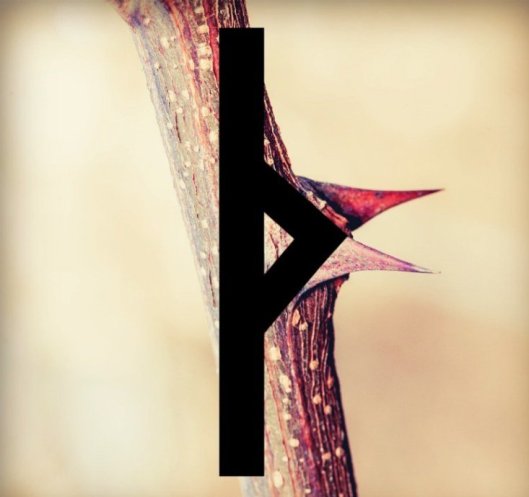
Phonetic value as “th” as in thorn.
Now this is either Þorn (Thorn) or Þyrse (Thyrse), depending, it seems, on your interpretation of the rune poems. Certainly, the meaning differs between the Icelandic and Norwegian rune poems as compared to the Anglo-Saxon and some have clearly mused on the possibility that the Anglo-Saxon scribe of the rune poem opted for a less “Pagan” version of the poem so as not to draw upon the mythology of giants and other creatures.
Despite the differences in the poems as regards to whether they refer to a thorn or a thyrse, the implications remain similar: This is not a good rune to see in a reading! Thorns are sharp and painful. They represent at the least, discomfort, and threat – even a place that is almost impossible to get to like the giant thorns that surrounded the palace during the 100-year slumber of Sleeping Beauty. The hawthorn tree is attributed with having blossoms which are considered unlucky to some. For me, the hawthorn is and was used as a barrier to farmers fields, a barrier between their land and that which is not their land. Inner and outer, a painful exit or a painful entry from one place to the next. The comparisons can be drawn between moving from one life event to another and having to endure significant hardship to do so.
Hawthorn berries, or haws, are usually bright red, the international symbol of danger. Despite this, the berries are believed to have several health benefits, loaded as they are with antioxidants in the form of polyphenols so at the right time of year, they can be prepared appropriately for consumption. Therefore, in my view this relates strongly to the very nature of life itself. If the rune presents itself during the season where it is in full fruit, then it may represent hardship coupled with potential reward – I.E. that the challenge will be testing, but there may also be a reward. But at what cost, however?
Uprooting a hawthorn is said to be bad luck, and similarly given that it represents painful challenge and potential misery, it is not a simple case of uprooting it at the source, it must be handled carefully, recognised for the fact that life yields challenges and rewards, not always in equal measure, but that no life will ever been complete if we have not had our capabilities tested from time to time.
When hawthorn is laid as hedgerows, over time it becomes an impenetrable mass, representative of what can happen in life if you ignore your problems for too long – they become very difficult to resolve! The rune itself clearly looks very much like an upright thorn and needs little in the way of understanding to perceive it as such. It is a warning when it appears in a divination, and warnings should be heeded. Consider again the position and prominence of it upon the cloth if you are scattering runes as the interpretation of the warning will hinge upon how close it is to your spiritual centre and what relationship it appears to be having with any other runes.
Clearly it suggests at the very least to proceed with caution. Keep your eyes open as although it represents a hazard, it does not necessarily mean interaction with that hazard is unavoidable. With preparation and understanding, you may be able to recognise the threat in time and avoid it, just as you would not wilfully blunder into a hawthorn bush. As a result of the cautionary nature of this rune, it is also a strong protective rune when employed in charms or bindrunes when it comes to protecting something you may not want to be commonly known. This is not necessarily in reaction to a known threat, more as a protective presence to prevent someone or something from blundering into your protected enclosure – like a runic hawthorn hedgerow.

