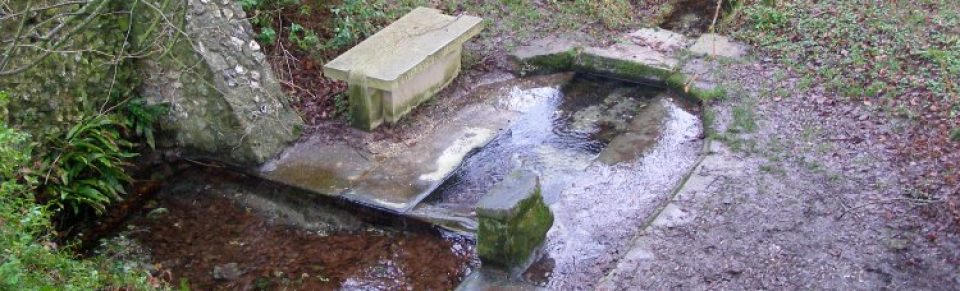
Follow below my visit to Cerne, to the Silver Well and to the Giant…
Arrival in Cerne Abbas (Video)
Towards the Silver Well (Video)
21 Tuesday Jul 2026
Posted in Uncategorized
Follow below my visit to Cerne, to the Silver Well and to the Giant…
Arrival in Cerne Abbas (Video)
Towards the Silver Well (Video)
03 Monday Apr 2017
Posted in Uncategorized
The people of Cerne were a hardy folk, well used to surviving amongst the chalk hills of the Cerne valley that rose up from the river of the same name. They grazed their cattle and sheep upon the land and they showed their gratitude to the gods with their sacrifices and offerings in keeping with tradition. There rose, within Cerne, a well-spring from deep under the chalk hills, known to the locals as the Seolfor Cwylla and it carried with it fresh water that it was said could cure the ills of the local folk and could be depended upon to water the fields and provide sufficient refreshment for the cattle so that the people of Cerne would continue to thrive when the skies ran dry during the Summer months.
There lived nearby a crone, bent and twisted with age and she took a copse of trees for her home high in the hills above Cerne. She was said to be a gyden who had lived in the hills for longer than man could remember, tending to the wild places and keeping them free from maleficent wihta and outlaws. She was said to be very wise and knowledgeable in the ways of healing worts and their applications. The folk of Cerne named her as Helið and took her for a goddess of their own. They would leave their offerings to her at the site of where the Seolfor Cwylla reached the surface, and merchants would throw pieces of silver downstream to pay their respects to Helið as their wares were pulled from one marketplace to another throughout the Frome Valley of Dorset and beyond.
Cerne was a place of peace and plenty for many a year until the coming of a mighty Hyll Þyrs one night following a mighty thunderstorm. The Þyrs appeared from out of the trees, carrying an enormous club hewn from the trunk of an oak. He was naked and proudly so, staking his claim to a new home on one of the hills above the village. From his lofty perch he demanded the villagers present him with sacrifices from their finest stock, and when at first they refused, he slew their strongest warriors with a single sweep of his mighty club. The villagers succumbed to his demands and despaired, their flocks of sheep and oxen rapidly diminishing as the Þyrs gorged itself on their carcasses. At night its heavy footsteps could be heard and felt around the village as it helped itself to more livestock.
It became known that whilst the Þyrs was in possession of its club, the Þyrs could not be defeated. Warriors came from near and far to take on the Þyrs and each were summarily beaten, slain and consumed by the Þyrs of Cerne, as it became known. The villagers knew not where to turn. Then one night the Þyrs discovered the Seolfor Cwylla, pushing aside the underbrush and attempts by the villagers to disguise their pure water source and, having developed a terrible thirst from the consumption of so many of the beasts of burden belonging to the villagers, he then gorged himself on the pure waters of the Seolfor Cwylla and drained it dry in a single sitting.
And thus did he anger Helið, as he drank the waters that fed the copse of trees within which she dwelt. Her anger was terrible to behold and it was said that the beasts and birds of the Ūtangeard did fall silent as she smouldered with fury within the dying trees of her home. Yet it was from here that she plotted her revenge. From stiðe she wove a net, strong and durable; lacing it with a deadly poison. Waiting until the moon was full, she strode down from her home, casting a glamour all about her such that she shone with the radiance of the full moon, her hair appearing as pure as the silver waters from the Cwylla and her countenance was said to be as fair as Frīg herself.
The Þyrs was stood high on its hill, looking down at the village as he intended again to help himself to the cattle and livestock, his hunger once again upon him. Helið approached from the mouth of the wellspring, striding with apparent swiftness towards the Þyrs. It beheld her as she approached and was struck dumb by her intense beauty. Such was its arousal at her countenance that it lowered its mighty club, leaving itself open to her approach. Helið did not falter. She did not delay but cast the net she had created wide, throwing it upon the Þyrs as it stood enraptured, the bonds tightening about it and the poison setting to its task with startling rapidity. The Þyrs bellowed in pain and surprise, its legs giving way beneath it such that it fell against the hillside with a mighty crash, its head striking the chalky earth so hard that its skull did break. Helið stood watching in silence, gathering in the net she had woven and stowing it safely away. The Cerne Þyrs was dead, and from its broken head did pour the waters of the Seolfor Cwylla, leaking back into the chalk hill.
The folk of Cerne rejoiced in the death of the Þyrs and Helið strode back through the village, her glamour now failing as the moon’s rays dissipated behind clouds, returning her countenance once again to that of the crone that she truly was. As she passed by the Seolfor Cwylla, the waters it had previously provided once again burst forth and with it returned the life and purity of the surrounding area. Helið returned to the hills to tend to the wild places once again, and the people of Cerne never again faced the threat of a Þyrs, marking the site of the dead creature by grinding its bones into the chalk beneath the grass of the hill which serving as a warning to others that here was one that met its end.
And the folk of Cerne created their idols to Helið in recognition of her deeds, and from that day until the coming of Augustine, they lived in harmony with one another and paid tribute to their goddess at the Seolfor Cwylla. Many now do not recall the deeds of Helið, but there are some that do and will always honour her. Should you pass through the village of Cerne in your travels, ensure you pay tribute to her at the Seolfor Cwylla, the Silver Well, which still runs to this very day through the heart of the village whilst the image of the defeated Þyrs remains imprinted for all time on the hill above it. On a moonlit night you may see her still, watching over the village and the hills above Cerne, bent and haggard with age and care, but determination burning from eyes of the purest silver.
A Fyrnsidere Journey Through Life
Faith in Thor. A Heathenship with him at the heart of it.
Fyrnsidu for the Future
Continental Saxon Heathenry
Heathen Spiritworker
European Medieval History from the Viking Age to the Hundred Years' War
A site for Fyrnsidu and Anglo-Saxon Heathenry
Custom of the New Galatîs
Anglo-Saxon Heathenry and Roman Polytheism

